TSMC cho biết đa phần các hãng chip sẽ bỏ qua tiến trình A16 để tiến thẳng lên A14
Tại sự kiện OIP ở Munich, TSMC hé lộ lộ trình công nghệ cho thấy dòng chip 2nm sẽ gắn bó lâu dài với thị trường. Phần lớn khách hàng dự kiến sẽ sử dụng các biến thể N2 rồi nhảy vọt thẳng lên tiến trình A14 thay vì chọn A16.
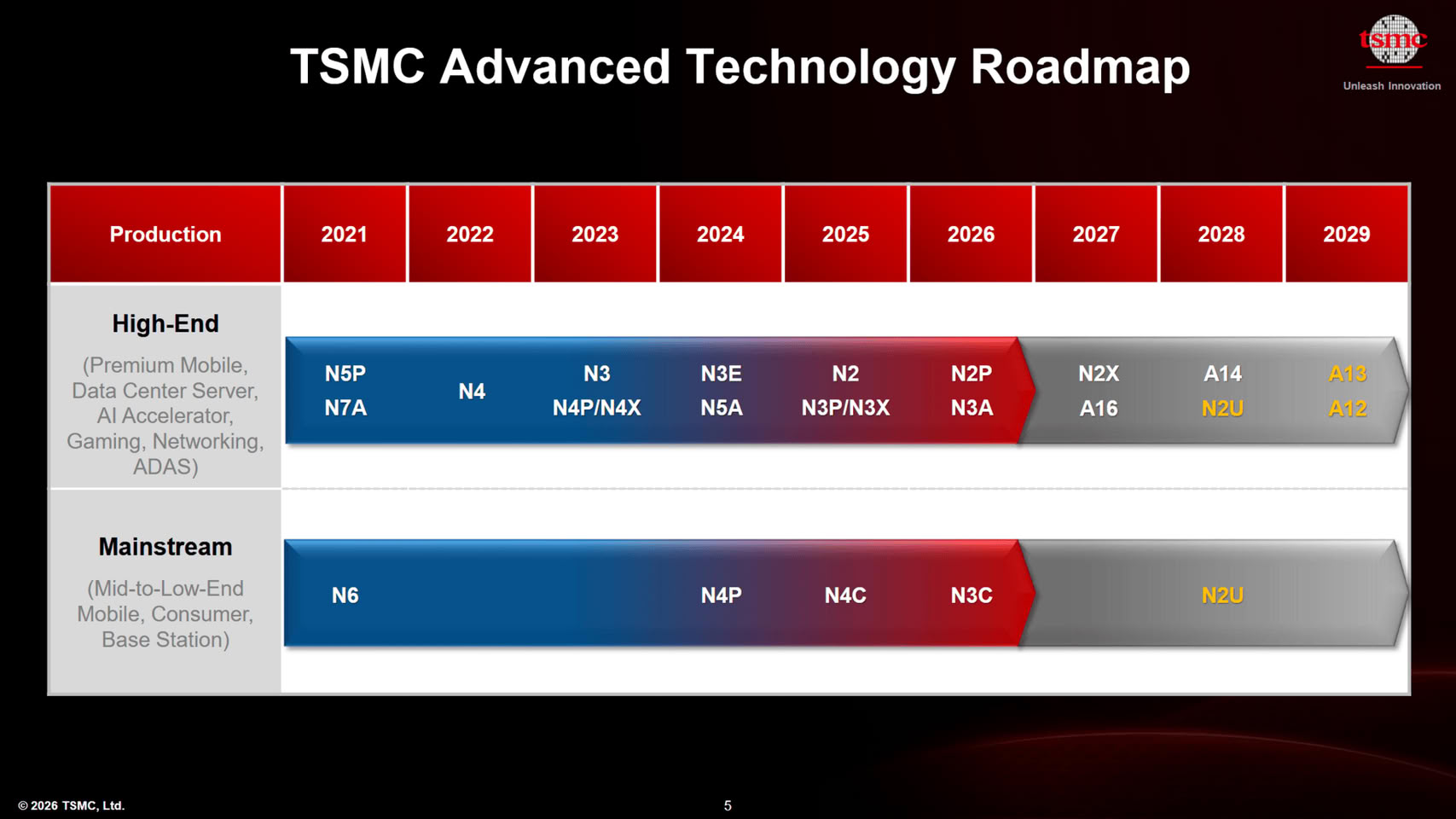
Earlier this week, TSMC held its Open Innovation Platform (OIP) forum in Munich, the first time the event has been held there. According to ComputerBase's coverage of the event, TSMC laid out a roadmap of its process nodes, and it looks like the 2 nm family is set to be a long-runner. According to the roadmap, most customers will stay on N2P, then move to N2U, and only then make the leap to A14. To recap, N2U is the final round of 2 nm tuning and is due in 2028. For that particular node, TSMC quotes roughly 4% more performance at the same power compared to N2P, and about 10% lower power at the same performance. Think of it as a refinement, just like Intel's 18A-P is over 18A.
The next mainstream node is A14, which is scheduled for 2028. That leaves the A16 node in a peculiar spot. It's essentially just N2P with backside power delivery, which TSMC brands as Super Power Rail, and its appeal currently looks limited to AI chips. We covered an earlier report that NVIDIA had secured A16 for its next-gen "Feynman" GPUs , which would make it the node's first customer. Apple has also been floated as a customer before, but previous reports have said that Apple hasn't even started talks with TSMC yet. Most of TSMC's major customers are eyeing the A14 jump instead. The roadmap also shows A13 and A12 lined up for 2029, but plans this far out can change and move around. However, we can expect most phones, laptops, and PC chips to stick with 2 nm-class silicon for now.
Nguồn: TechPowerUp · Bản dịch tiếng Việt của VGSNews, chỉ để tham khảo.